

Building an AI-Ready Foundation: What Most Companies Get Wrong
- Karl Aguilar
- May 29
- 4 min read
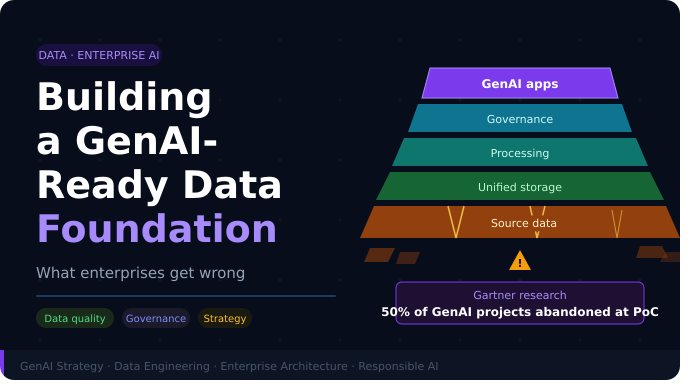
AI adoption is accelerating across every industry.
Executives are under pressure to improve productivity, automate workflows, and unlock new insights through Generative AI. At the same time, there is growing concern that organizations that fail to embrace AI risk falling behind more agile competitors.
Yet despite the excitement, many companies struggle to move beyond pilot projects and isolated use cases.
The problem usually isn’t the AI model.
It’s the foundation beneath it.
Organizations rush to deploy AI hoping to transform operations, only to discover that fragmented data, inconsistent definitions, and weak governance limit the value AI can deliver. Rather than creating clarity, AI often amplifies existing problems at greater speed and scale.
This is why so many AI initiatives fail long before they generate meaningful business outcomes.
Why AI Initiatives Stall
Research consistently shows that a significant percentage of AI projects never progress beyond proof-of-concept. While the reasons vary, most failures can be traced back to five common issues.
Unclear Business Outcomes
Many organizations start with the technology instead of the business problem.
Leaders become excited by AI’s capabilities and attempt to deploy it across multiple functions simultaneously. Without clearly defined objectives, measurable success criteria, or prioritized use cases, AI initiatives become experiments rather than investments.
The result is predictable: lots of activity, little business value.
Poor Data Foundations
AI is only as reliable as the data it consumes.
Incomplete records, inconsistent definitions, duplicate entries, and disconnected systems all reduce the quality of AI-generated outputs. Even the most sophisticated models struggle when underlying data lacks accuracy, context, or governance.
Organizations often discover too late that AI doesn’t solve data quality problems.
It magnifies them.
Rising Operational Costs
Many AI projects appear inexpensive during testing but become significantly more costly at scale.
Usage costs, infrastructure requirements, governance controls, monitoring, security, and integration efforts all contribute to total cost of ownership. Without visibility into how costs scale across users and use cases, organizations can quickly find themselves investing more than anticipated with unclear returns.
Weak Governance and Risk Management
Governance cannot be treated as an afterthought.
Privacy concerns, security risks, intellectual property exposure, hallucinations, bias, and regulatory requirements all introduce new challenges for organizations deploying AI. Without clear policies and accountability structures, organizations expose themselves to operational, reputational, and compliance risks.
Low Organizational Adoption
Even technically successful AI solutions can fail if employees don’t trust them or understand how to incorporate them into daily workflows.
Organizations that neglect training, communication, and change management often encounter resistance, low adoption rates, and inconsistent usage across teams.
Successful AI initiatives require people to evolve alongside the technology.
What Successful AI Adoption Looks Like
Organizations that successfully scale AI tend to focus less on the technology itself and more on the operational foundations that support it.
Business Alignment Comes First
AI initiatives should begin with clearly defined business objectives.
Whether the goal is improving operational efficiency, accelerating decision-making, reducing costs, or enhancing customer experience, every AI initiative should be tied to measurable outcomes and business priorities.
The technology should support the strategy—not drive it.
AI Must Fit Existing Workflows
The most successful AI deployments are embedded into the systems and processes employees already use.
When AI becomes part of existing workflows, adoption improves naturally because it removes friction rather than creating new processes. Organizations should focus on integrating AI into day-to-day operations instead of introducing standalone tools that create additional complexity.
Workforce Readiness Matters
Long-term success depends on people.
Employees need training, support, and confidence in how AI is being used within the organization. Leaders should clearly communicate how AI enhances productivity and decision-making rather than framing it as a replacement for human expertise.
Organizations that invest in AI literacy create stronger adoption and better outcomes.
Governance Must Be Built In
Security, privacy, compliance, and accountability should be embedded into every stage of AI implementation.
This includes clear policies governing data access, model usage, auditability, and regulatory compliance. Strong governance frameworks create trust while reducing organizational risk.
Data Excellence Remains the Differentiator
No factor influences AI performance more than data quality.
Reliable AI requires data that is accurate, complete, governed, and consistently defined across the organization. Metadata, lineage, interoperability, and transparency all play important roles in ensuring AI systems generate outputs that users can trust.
The organizations seeing the strongest AI results are often the ones that spent years building disciplined data practices before deploying AI at scale.
Human Oversight Remains Essential
AI works best when it augments human expertise rather than attempting to replace it.
Humans provide judgment, context, ethical oversight, and business understanding that
AI cannot fully replicate. The most effective operating models combine AI-generated recommendations with human decision-making and accountability.
Building an AI-Ready Data Foundation
For most organizations, becoming AI-ready starts with strengthening the underlying data environment.
Build an Inventory of Critical Data
Organizations should identify where business-critical data resides, how it moves between systems, and where quality issues exist. Understanding the current state creates the foundation for future improvement.
Align Business and Technology Teams
Data quality is not solely an IT responsibility.
Business leaders, operational teams, and technology stakeholders must work together to establish ownership, definitions, standards, and accountability. AI success depends on organizational alignment as much as technical capability.
Establish Strong Data Governance
Effective governance ensures consistency, security, compliance, and trust across the data ecosystem.
Organizations should define clear policies around access controls, data ownership, quality standards, retention requirements, and regulatory obligations.
Treat Data Quality as an Ongoing Service
AI readiness is not a one-time project.
Data must be continuously monitored, validated, governed, and improved as systems, processes, and business requirements evolve. Organizations that treat data quality as an ongoing operational discipline create a stronger foundation for analytics, automation, and AI.
Final Thought
Many organizations assume AI readiness begins with selecting the right model.
In reality, it begins much earlier.
With trusted data.
The companies generating meaningful returns from AI are not necessarily using the most advanced models. They are the organizations that invested in clean data, strong governance, operational discipline, and organizational alignment before scaling adoption.
Platforms like Pandoblox Signal help establish that foundation by creating a centralized, governed data environment that connects systems, standardizes definitions, and delivers trusted information across the business.
Because when it comes to AI, the quality of the outcome is ultimately determined by the quality of the foundation beneath it.



Comments